Automated Canister Capping, Marking and Palletizing
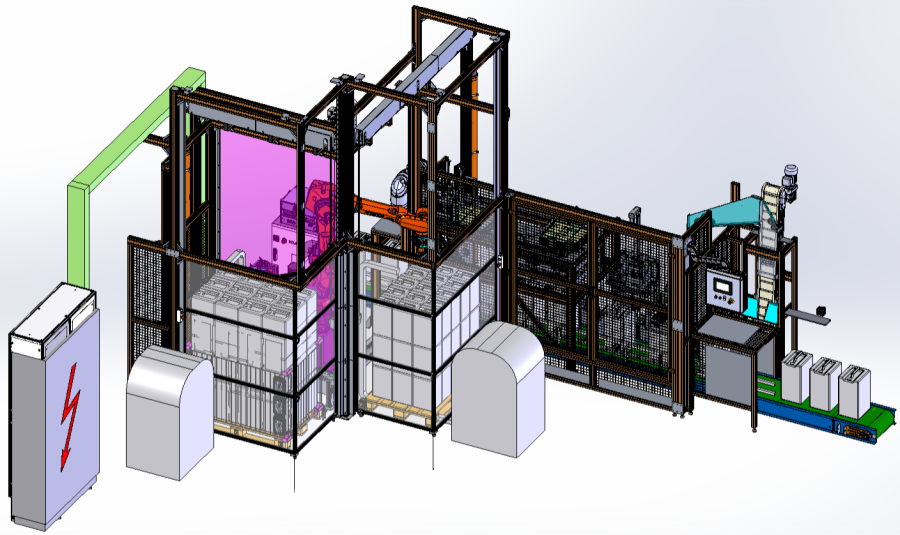
Automated Handling from Canister Infeed to Final Palletizing
This compact automated workstation integrates canister conveying, cap placement and tightening, label application and final robotic palletizing. The solution is designed to accommodate multiple canister sizes and reduces the need for manual handling throughout the entire process.
How the Solution Works
Canister Infeed and Positioning
Canisters are transported by a belt conveyor and accurately positioned for subsequent operations using a centering and clamping system.
Automatic Capping
Caps are fed from a hopper by an elevating conveyor and sorted into magazines according to their size. Capping is performed to a defined number of rotations, with the achieved tightening torque monitored.
Label Application
Labels are applied robotically with camera-based inspection. Due to the large number of product variants, the labels are supplied on sheets rather than in conventional rolls.
Robotic Palletizing
Final handling is performed by an industrial robot equipped with a tool changer and two types of tools. Canisters can be placed directly onto pallets or into wire mesh containers according to a predefined packaging specification.
Key Benefits of the Solution
- Automated handling of multiple canister sizes: 5 L, 15 L, 20 L and 25 L
- Controlled cap placement and tightening
- Consistent label application with camera-based inspection
- Robotic palletizing onto pallets or into wire mesh containers
- Tool changer with two types of palletizing tools
- Stable product placement according to a predefined packaging specification
- Automated material flow between individual operations
- Reduced need for manual operation and handling